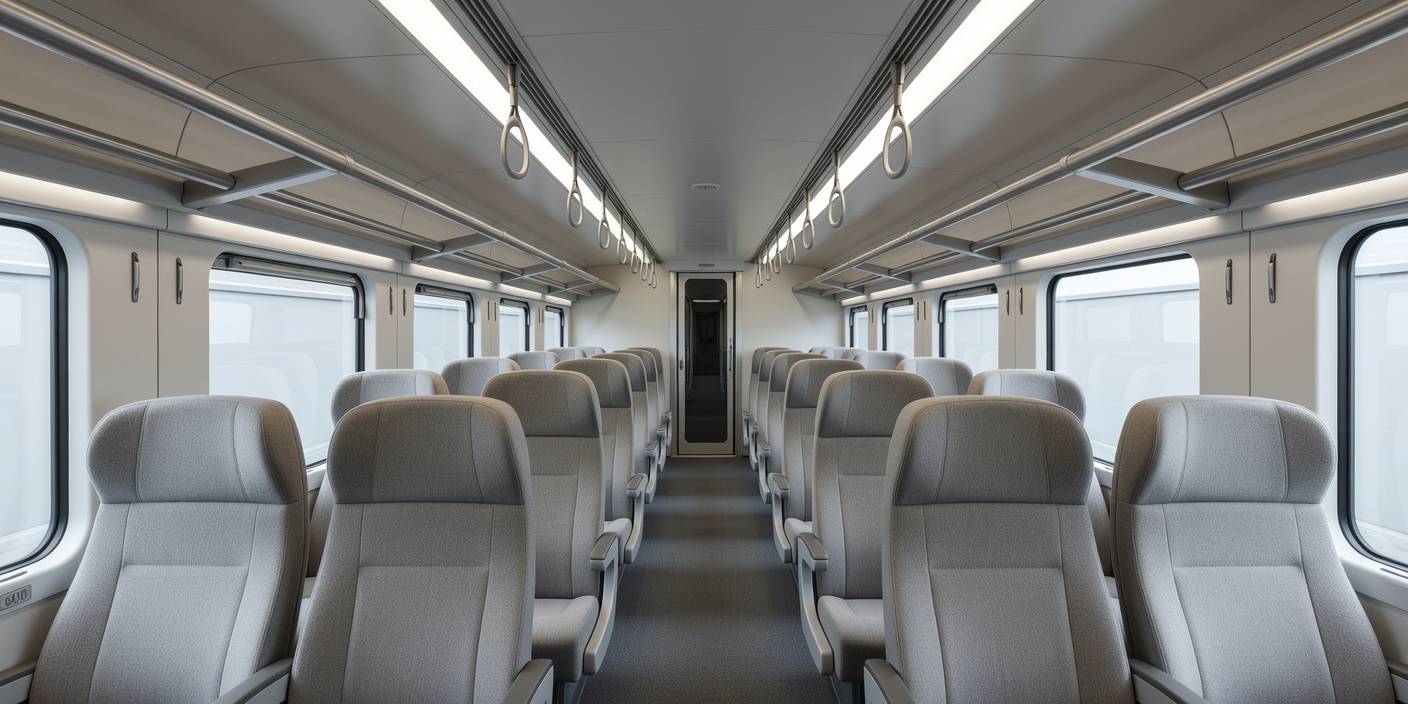
The unique physics of the passenger saloon
When a six-car regional commuter set finishes a morning peak sequence, it may have carried over four thousand passengers through its saloons. Each commuter leaves behind dust, food oils, rain runoff from outer garments, and contact sebum on door push-buttons and luggage racks.
Cleaning this environment is not simply about deodorising or quick sweeping. Railway interior materials must satisfy strict European fire and toxicity norms (such as EN 45545-2). Standard industrial cleaning agents with aggressive solvents or high pH can degrade the flame-retardant chemistry woven into moquette seating, weaken polycarbonate seat-back shrouds, or leave sticky residue on acoustic ceiling baffles.
Passenger seating: fabrics, vinyl, and composite frames
Seat hygiene requires careful material classification. Wool-blend moquette seats rely on tight weaves that trap particulates near the surface. Routine vacuuming with micro-filtration wand heads removes abrasive quartz particles before they grind down backing fibres. For spot-stain rectification—like spilled coffee or fruit juices—neutral detergent foaming agents are applied with minimal moisture, preventing water from penetrating into underlying combustion-modified polyurethane foam cores.
In suburban or transit stock featuring wipe-clean polyurethane or vinyl finishes, mechanical scouring must be avoided to keep the antimicrobial top barrier from micro-fracturing.
Flooring systems and vestibule door channels
Carriage floors undergo severe mechanical abrasion. Modern railway flooring typically consists of weld-sealed linoleum or slip-resistant vinyl impregnated with silicon carbide particles. Cleaning crews follow a strict top-to-bottom sequence: waste removal first, overhead clearing second, and floor neutral-damp washing last.
Particular care is given to the sliding door pockets and lower guide tracks. If grit accumulates in door thresholds, automated pocket doors can fault out during station halts, triggering mainline delays. Vacuum crevice tools and nylon bristle clearing prevent track fouling without damaging sensitive optical door sensors.
Universal washrooms and sanitary modules
Accessible washroom pods in European passenger trains operate on closed vacuum systems with stainless steel bowls, composite walls, and motion-activated faucets. Because ventilation is mechanically induced and shared with exhaust plenums, chemical choice is heavily restricted.
Acidic descalers may only be used on designated stainless components to clear lime and uric scale; they must never contact adjoining anodised trim or rubber vacuum seal rings, which turn brittle if exposed to low-pH washes.
High-touch points and cabin driver cabs
Grab poles, overhead handles, armrests, tray tables, and passenger emergency call buttons receive microfibre sanitiser wiping. Cleaners follow an 'S-pattern' stroke to prevent redistributing soils.
In driver cabs, ergonomics and instrumentation take precedence. Multi-function displays, brake controller grips, and master keys require non-streaking, static-dissipative solutions. Sprays are never misted directly onto electronic consoles; cloths are lightly pre-wetted to prevent capillary seepage into circuit board enclosures.
Drying times and turnaround constraints
Passenger carriage air conditioning systems exchange air rapidly while running, but stabled trains may have HVAC running in low-power stabling mode. Interior cleaning protocols must limit liquid application to ensure fabrics and floors dry before passengers re-board, preventing slip hazards and mould incubation.
Operational Checklist: Passenger Saloon Cleardown
Comparison: Routine Turnaround vs Interior Deep Clean
| Element | Routine Platform / Depot Turn | Scheduled Interior Deep Clean |
|---|---|---|
| Litter & Waste | Bag removal, bin liner replacement | Bin housing disassembly, sanitisation behind liners |
| Seats & Upholstery | Dry sweep, urgent spot stain clearing | Full hot-water extraction, seam brush, fabric testing |
| Floors | Targeted sweeping, spot mopping in aisles | Machine agitation, skirt edge detailing, gum stripping |
| Washrooms | Surface disinfection, restock paper & soap | Vacuum line rinse, lime breakdown, drain pipe flush |
| Air Diffusers | Surface dusting of visible grilles | Diffuser removal, filter media inspection & vac |