The choreography of rapid railway turnarounds
When an intercity service pulls into a terminal station, the dwell time before its return journey is often counted in minutes, not hours. Passengers disembark with heavy luggage, and within a narrow window, the trainset must be swept, sanitised, restocked with washroom consumables, and prepared to welcome the next boarding queue.
This turnaround cleaning represents one of the most intense operational balancing acts in passenger transport. If the cleaning team overruns by even three minutes, the train misses its scheduled departure path, propagating signal delays across heavily congested European mainline corridors.
Terminal platform turnarounds vs stabling yard cleans
It is critical to distinguish between terminal platform turnarounds and depot stabling cleans:
- Platform Turnaround: Executed at active passenger platforms. The cleaning team boards as soon as passengers clear the doors. Equipment must be lightweight and battery-powered or manual (no loose cables or cumbersome wet mops). Tasks are tightly prioritised: clearing bulk trash, changing bin liners, wiping visible spills, checking toilet cleanliness, and restocking paper supplies.
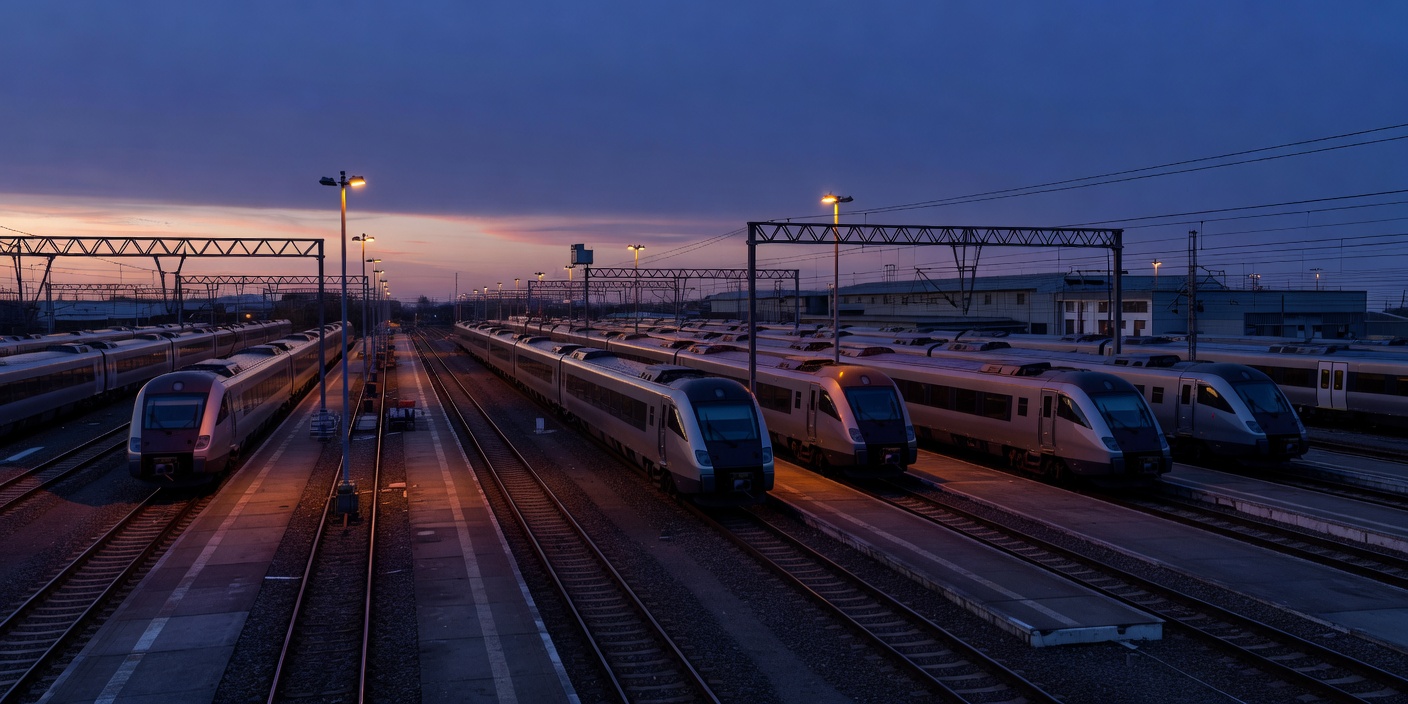
- Depot Stabling Clean: Carried out overnight or during off-peak stabling hours in railway yards. Teams have access to shore power (230V/400V), compressed air, and water lines. Here, thorough vacuuming of seat runs, aisle mopping, glass defingerprinting, and full cab disinfections are completed without passenger pressure.
Team sequencing and movement patterns
Efficient turnaround requires disciplined car-by-car zoning. In an eight-car formation, a team of four to eight operatives splits into coordinated pairs. Pair A enters from Car 1 moving inward; Pair B enters from Car 8 moving inward.
Within each carriage, the lead operative conducts a "coarse pass"—bagging newspapers, coffee cups, food containers, and clearing overhead racks. The second operative follows immediately with high-touch sanitising wipes for tables, armrests, and door buttons, while restocking the universal washroom pod. By moving in a continuous forward vector, cleaners avoid crisscrossing and doubling back.
Depot track safety and traction movement coordination
Working in stabling yards introduces significant physical hazards. Tracks are live, shunt locomotives move stock between servicing lines, and third-rail or overhead wire currents remain active unless isolated.
Cleaning personnel operating trackside must hold accredited railway safety certifications (such as Personal Track Safety / PTS equivalents across Europe). Red-zone working is prohibited; cleaning crews never cross tracks without designated walkways and clearance from the yard shunter or depot controller. Inside carriages, cleaners ensure that all doors on the non-serviced 6-foot track side remain locked to prevent accidental falls into adjacent running tracks.
Waste handling and biological hazard protocols
Railway waste collection requires robust containment. Sharp items, glass, or biological spills (such as passenger motion sickness) require dedicated sharps kits and bio-hazard neutralising powders. Waste collected during platform turns is bagged in heavy-duty puncture-resistant sacks and transferred directly to platform-level secure compaction bins, preventing wind-blown track ballast littering.
Turnaround Workflow Sequencing: 20-Minute Platform Turn
| Time Window | Team Movement | Primary Activity | Quality Checkpoint |
|---|---|---|---|
| T+0 to T+3 min | Wait at platform markers; board immediately upon passenger egress | Initial scan for unattended baggage / security items | Security clearance confirm |
| T+3 to T+10 min | Coarse pass moving inward from outer driving cabs | Bulk litter collection, overhead rack sweeps, waste bin clearing | Bins relined; aisles clear of debris |
| T+10 to T+16 min | Secondary pass through tables and sanitary pods | Tray table wiped, grab handle wipe-down, toilet restock & bowl check | Toilets clean and operational |
| T+16 to T+18 min | Floor spot-check and entrance threshold clearing | Spot wipe liquid spills, clear door runners of trapped stones | Floor dry and safe for boarding |
| T+18 to T+20 min | Egress carriage via designated platform door | Waste transfer to depot platform compactor; handoff to train manager | Lead sign-off given to train crew |