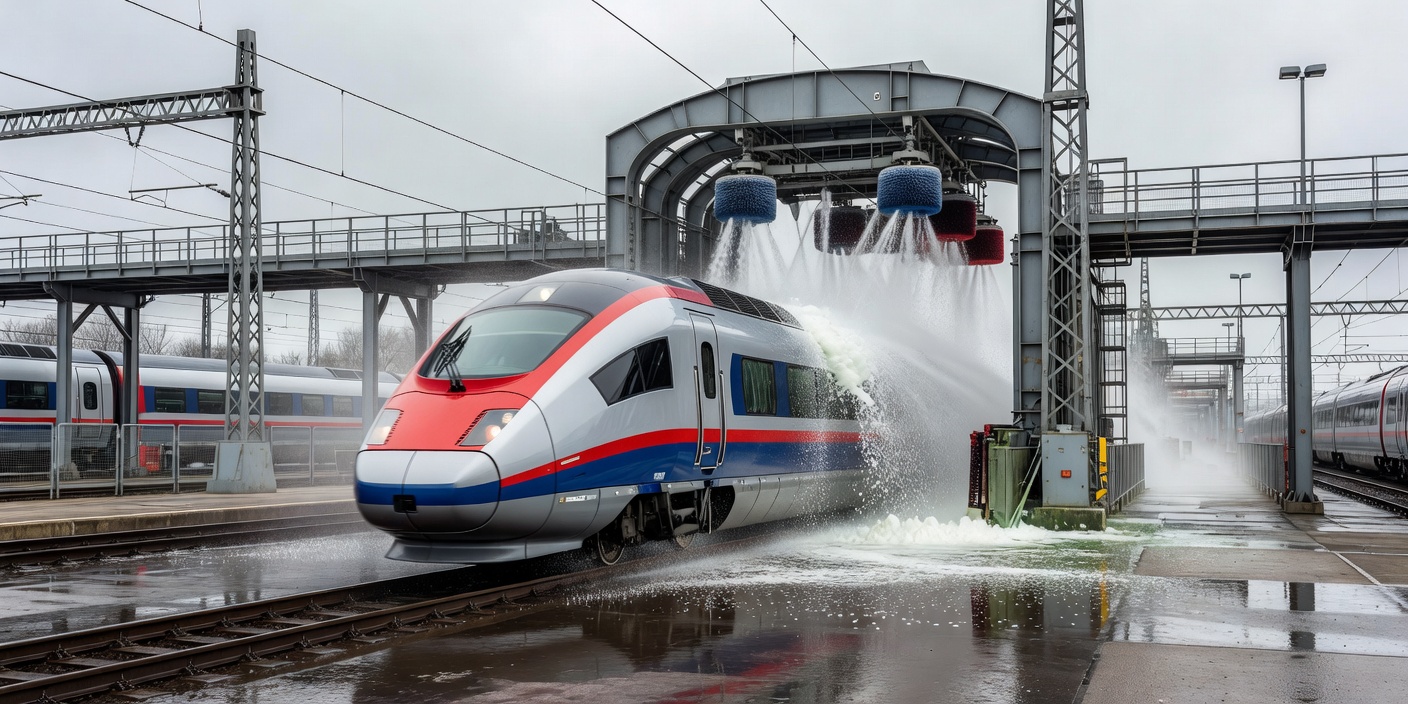
Why rolling stock exteriors defy conventional fleet washing
An eight-car electric multiple unit travelling across European open country faces a combination of environmental and mechanical soils unseen in automotive or bus fleets. High operational speeds project airborne insects and pollen into the aerodynamic nose cone at 160 to 300 km/h. At the same time, carbon contact strips on the pantograph wear down under overhead wires, throwing fine graphite and copper particulates across the carriage roofs and sidewalls.
Below the window line, disc brakes and cast-iron shoes generate microscopic hot iron particles that bite into clear-coat finishes. Left unaddressed, this ferrous film oxidises, turning carriage liveries dull and reddish-brown while corroding rubber window seals and exterior door button actuators.
Automated carriage wash plants (CWP)
The workhorse of depot exterior maintenance is the automated Carriage Wash Plant (CWP). Trains are driven through the wash track at a controlled crawl speed (typically between 3 to 5 km/h). The gantry sequence begins with optical or track-circuit detection, initiating a pre-wetting arch followed by chemical dosing.
Rotary brushes fitted with foamed polyethylene or microfibre strands contour to the train's curved side panels. Unlike older nylon bristle brushes, modern synthetic media minimise micro-scratching on polyurethane liveries and clear safety coatings.
However, automated brush arches cannot safely navigate complex 3D contours, such as recessed cab steps, windshield wiper assemblies, coupler pockets, and recessed gangway bellows. These remain the territory of targeted manual lancing.
Manual lance washing and nose cone detailing
The driving cabs and front ends of modern trainsets present aggressive curves, sensor radomes for train protection systems (such as ETCS), and heavy insect buildup. Manual teams work from designated platform walkways equipped with fall protection.
Technicians use warm, low-pressure foam application (typically 40 to 60 bar) combined with soft-bristled telescoping brushes to dissolve biological matter before it bakes under the sun. Pressure is kept moderate around cab front glazing seals and windscreen washer jet nozzles to prevent liquid ingress into wiring harnesses.
The roofline and electrical clearance requirements
The carriage roof is one of the most chemically contaminated parts of any electric train, yet it is also the most dangerous to service. Overhead contact wires carry high voltages (15kV or 25kV AC in much of Western and Northern Europe, 1.5kV or 3kV DC in Southern networks).
Roof cleaning can only proceed inside specialised depot tracks where the catenary is physically isolated, earthed, and confirmed with visual key-interlock systems. Once safe, maintenance crews apply oxalic or citric-acid-based formulations to neutralise baked carbon residue around transformer insulators and pantograph articulation arms.
Depot water treatment and closed-loop filtration
A single train wash can consume 1,500 to 3,000 litres of water. Modern European depot infrastructure relies on closed-loop reclamation plants. Sand filters, oil-water separators, and biological aeration beds treat greywater, allowing 70% to 85% to be reused in preliminary rinse arches. The final spot-free rinse uses demineralised water to prevent lime spotting on passenger glazing.
Exterior Cleaning Methodology Comparison
| Method | Cycle Speed | Primary Target Areas | Operational Limitation |
|---|---|---|---|
| Drive-Through CWP | 10–15 mins per trainset | Vertical bodysides, saloon glazing | Cannot reach nose cones, cab steps, underframes |
| Gantry Stationary Wash | 20–30 mins per trainset | Full length, side sills, lower skirts | Requires dedicated stabling bay without through-traffic |
| Manual Platform Lancing | 30–45 mins per cab / set | Nose front, cab glass, coupler pockets | Labour-intensive; requires ergonomic platform gantries |
| Acidic Descaling Wash | Periodic (every 30–60 days) | Oxidised ferrous brake film on lower sills | Requires strict effluent neutralisation before drainage |